AC capacitor buying only looks routine on a spreadsheet. In the warehouse, the problems are more ordinary: a can is a few millimeters too tall, a terminal is not where the technician expected it, or the label leaves quality staff guessing which test condition was used.
This guide is for HVAC buyers, OEM engineers, distributors, and service teams comparing AC capacitor suppliers in 2026. The goal is simple: check the part the way it will be installed, tested, and reordered, instead of approving it from a catalog photo.
Begin with the motor, not with the supplier's nearest catalog match. Capacitance is normally shown in microfarads, written as µF or MFD. For a replacement or alternate source, pull the value from the original nameplate, service manual, schematic, or engineering drawing. A larger value is not a free upgrade; in the wrong circuit it can raise current and heat. A lower value may leave the motor slow to start, noisy, or inefficient.
Voltage is a separate check. The replacement should meet or exceed the required AC voltage rating, but that alone does not approve the part. Frequency, tolerance, temperature, life rating, and operating duty still have to fit the equipment. Keep µF and VAC as two different approval lines.
Mechanical details are where many substitutions fail. Measure case diameter, height, mounting stud, clamp space, terminal spacing, and wire exit direction. A small height change can hit the cabinet cover. A new tab position can make a field repair look easy while quietly creating a wiring risk.
For dual-run capacitors, mark common, compressor, and fan terminals before sample approval. The right µF value on the wrong terminal is still wrong. Ask for a drawing that shows dimensions, terminal marks, tolerance, and any pressure-interrupt or overpressure feature.
For compressor and air-conditioning motor work, the source groups CBB65 with that service. The CBB65 build is metallized polypropylene film in an aluminum shell with oil filling. The same source describes use with 50/60 Hz single-phase motor starting and running; listed applications include air conditioners, washing machines, dishwashers, fans, and compressors. Its listed strengths include stability, self-healing behavior, low loss, and an explosion-proof device. The source allows long-term operation at 1.1 times rated voltage and steady-state overcurrent up to 1.3 times rated current.
For a CBB65 inquiry, send the capacitance combination, voltage class, can size, terminal style, temperature requirement, and expected approval documents. Then compare the quotation with the CBB65 AC capacitor product page and the physical sample label before issuing the order.
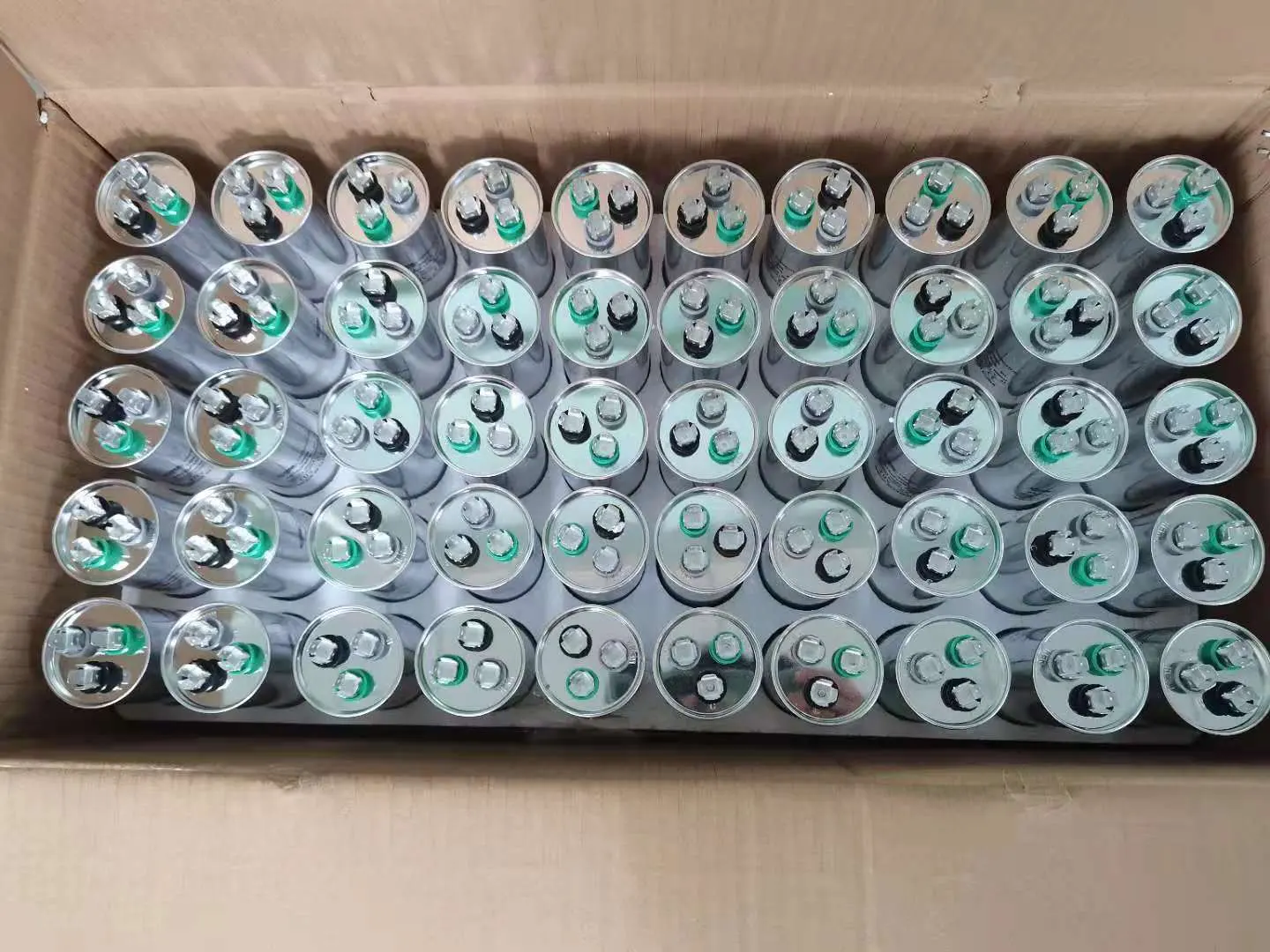
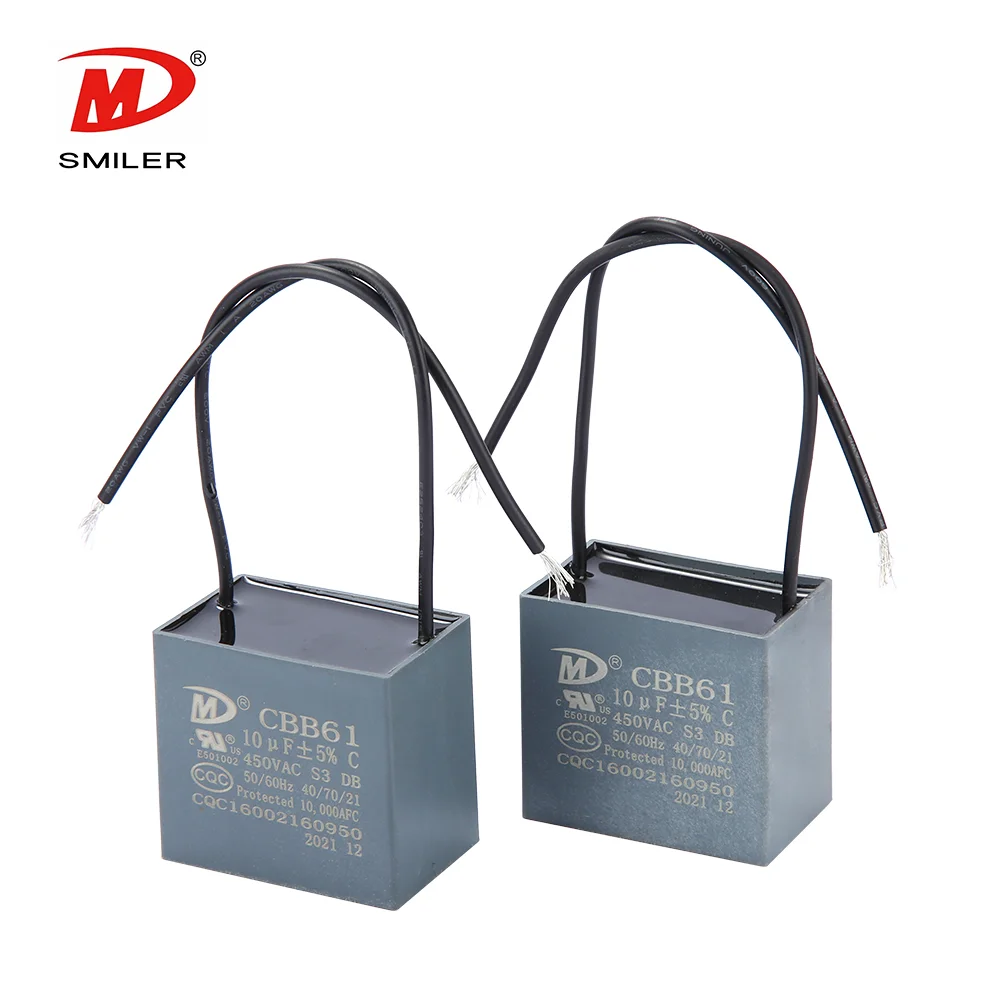
CBB61 tends to appear where the motor assembly is compact, especially in fan-related equipment. For CBB61, the source gives metallized polypropylene film, a flame-retardant plastic shell, and UL94 V-0 resin filling. Fans, ventilators, and air purifiers are the stated applications. The same family notes low loss, low internal temperature rise, reliability, self-healing property, and long lifetime. Use the CBB61 fan capacitor product page to check the family and application wording.
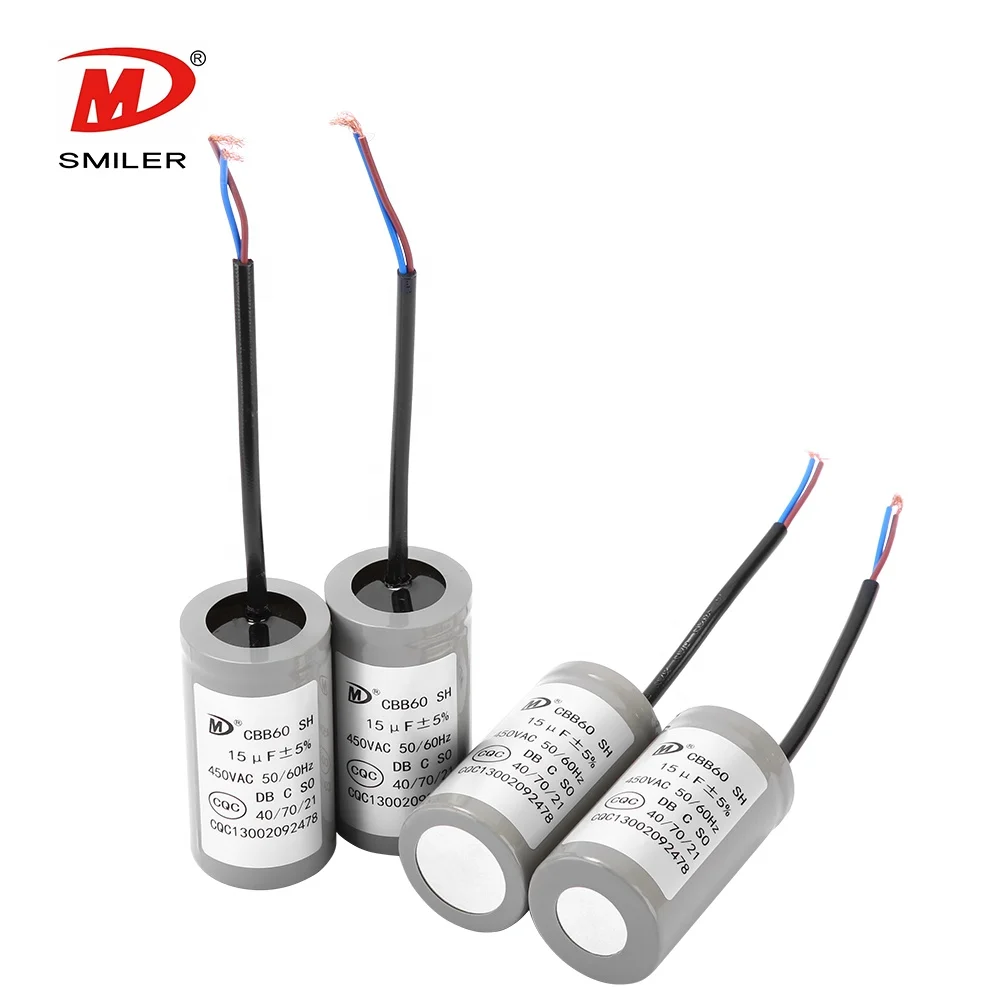
The source places CBB60 in the appliance and AC motor capacitor group. Its construction uses metallized polypropylene film with plastic or aluminum shell options. Listed applications include washing machines, shutter motors, range hoods, paper shredders, and water pumps. That does not make it interchangeable with every HVAC capacitor position; the motor's approved operating point still controls the choice.
Do the dull paperwork first, because it prevents expensive arguments later. Ask for the datasheet, outline drawing, sample label, electrical test condition, safety evidence, and lot trace method. For the AC capacitor families used here, the source range is 110V to 600V AC rated voltage with 50/60 Hz operation and ±5% or ±10% capacitance tolerance by code. Tolerance is stated as ±5% for code J or ±10% for code K.
Those values are useful for screening, but final approval still belongs to the drawing and sample for the HVAC system. If a running capacitor style is under review, compare the drawing against the CBB60 running capacitor product page and ask the supplier to point out any difference in shell, lead, label, or test condition.
SMILER capacitor began with AC film capacitors and later expanded toward a wider film-capacitor portfolio for power electronics. Our team can review capacitance, voltage, dimensions, and application notes before production so the discussion starts with a defined part rather than a vague category.
After the technical match looks reasonable, ask the commercial questions. Can the supplier hold a private label format? Can they separate lots? What happens if the terminal, resin, carton, or label artwork changes? What minimum order quantity applies to a mixed capacitance order?
A low unit price is not a win if every repeat order needs detective work. For regular HVAC programs, keep the approved drawing, sample approval date, incoming inspection limits, carton identification, and change-notification rule in one file.
Create one row for each capacitor position. Record motor function, capacitance or dual-run combination, rated voltage, frequency, tolerance, case size, terminal map, mounting method, ambient temperature, expected life, and approval requirement. Add the source of each value: nameplate, wiring diagram, service record, or engineering drawing.
Then split the row into fixed fields and proposal fields. Capacitance, voltage, terminal assignment, and envelope size are usually fixed. Label layout, carton quantity, and lead length may be negotiable if electrical and mechanical approval stays intact.
Treat the first sample as evidence, not decoration. Measure capacitance, insulation performance, dimensions, terminal strength, markings, and workmanship. For a dual-run capacitor, test each section separately and confirm the common terminal.
After approval, incoming inspection should compare lot labels, capacitance spread, case dimensions, and terminal orientation with the approved sample. A familiar part number is not proof that construction stayed unchanged, so the supplier should disclose material, process, or tooling changes that affect fit or performance.
The first mistake is approving a substitute because the can looks close enough. Similar shape can hide a different tolerance, terminal map, case height, temperature limit, or duty type. The second mistake is choosing by VAC alone. Voltage rating matters, but it does not fix the wrong capacitance or turn a start-only part into a run-duty part.
Weak documentation is another warning sign. If the supplier cannot provide a clear drawing, test condition, tolerance definition, and lot trace, the cheaper quote may cost more in inspection time. Use the full electrical and mechanical specification, approve a measured sample, and keep that record for the next replacement.
A: Check capacitance first, including the dual-run combination when one is used. Then confirm voltage, frequency, tolerance, terminal assignment, and case size against the approved motor or HVAC drawing.
A: It can, but only when the rest of the specification also matches. Capacitance, frequency, terminals, size, temperature rating, and safety requirement still need their own checks.
A: No. CBB65 is common in compressor and air-conditioning motor service, but the right family depends on the circuit, capacitance combination, enclosure, terminals, and approved operating condition.
A: Ask for the datasheet, outline drawing, test condition, sample, compliance evidence, lot trace method, packaging details, and change-notification process. The approval record should be easy to audit later.
A: Match the original electrical and mechanical requirements, verify the terminal map, test a sample in the intended assembly, and inspect production lots against the approved specification. Do not choose by appearance or price alone.
 Add
Building 12,Huazhi Technology Innovation Center,28 Sanle East Road,Beijiao,Foshan,Guangdong,China
 Phone
+86 18007576965 / 0757-22391591
 Email
ari@sml-cap.cn