In a CBB60 capacitor specification, μF shows capacitance. 450VAC shows the rated alternating-current voltage. 40uF gives the listed capacitance value. You must read the three together. This step is necessary. A replacement must meet the motor circuit needs for capacitance, voltage, duty, terminals, and physical requirements. A single number on a label cannot confirm interchangeability.
Microfarads measure capacitance. This is the amount of electrical charge a capacitor can store per volt. It uses the set conditions. In a single-phase motor circuit, the capacitance influences phase shift. As a result, it changes starting torque, running current, and speed behavior. A 40uF capacitor has far bigger listed capacitance than a 4uF part. So the two are not substitutes. This holds even if their cases look similar.
Capacitance is usually shown with a tolerance. If a label states ±5%, a listed 40uF value would have an expected range of roughly 38 to 42uF. This range depends on the manufacturer's test conditions and instrument accuracy. Use the actual marking on the part. Do not assume every CBB60 has the same range.
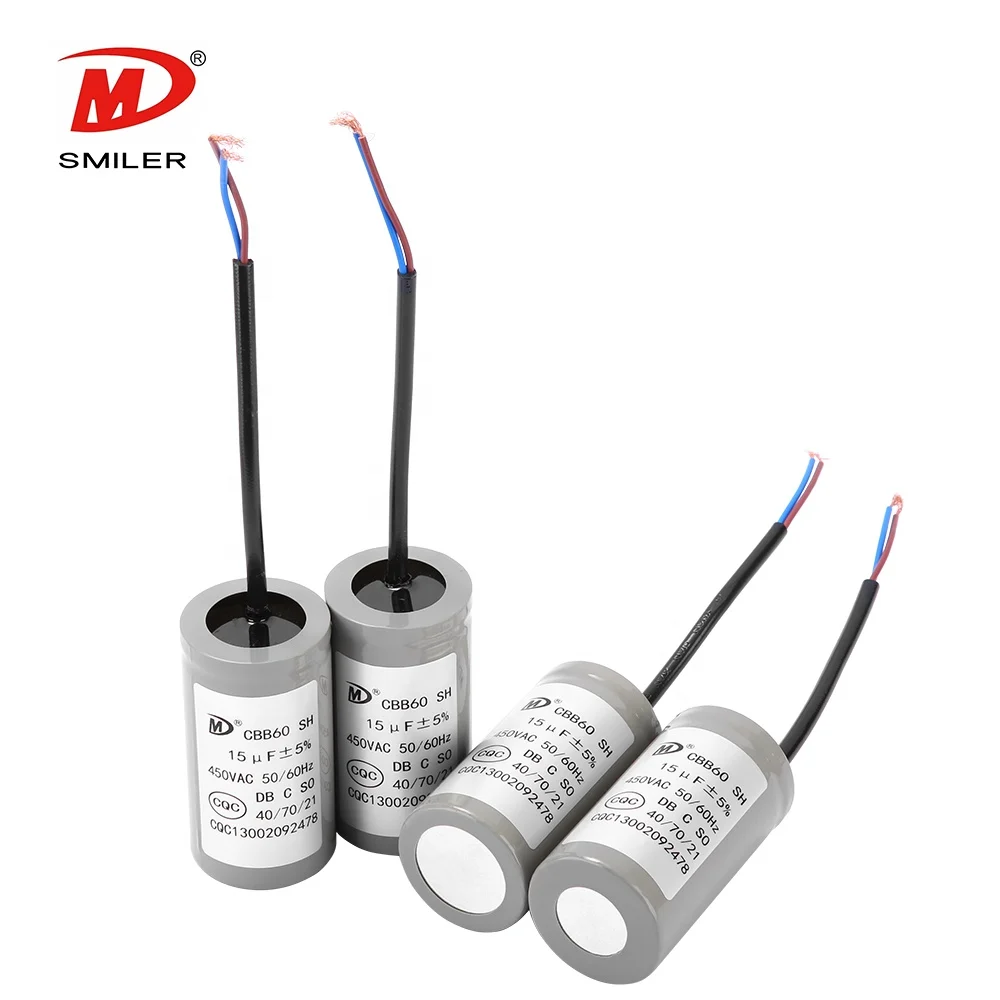
450VAC is the rated alternating voltage for the capacitor. It depends on the set frequency, temperature, life, and test conditions. It is not a claim that the capacitor should be connected to any 450-volt circuit without careful review. The applied voltage waveform, transients, frequency, temperature, and motor duty all matter.
The voltage rating does not increase the μF value. A 450VAC, 40uF capacitor still has a listed 40uF capacitance. A lower voltage replacement cuts voltage margin. A higher voltage marking may be acceptable only when capacitance, duty, size, terminals, and the equipment requirements also match.
CBB60 capacitors work with single-phase AC motors for starting and running applications. The value chosen by the motor designer supports the intended phase relationship. Too little capacitance may cut starting torque. It can cause humming or leave the motor slow. Too much can raise auxiliary-winding current. It can increase temperature and speed up insulation stress.
The approved product information identifies CBB60 as a family for starting and running single-phase 50/60 Hz motors. It does not assign 40uF or 450VAC to every CBB60 part. Confirm the exact marking, tolerance, and application first. Then treat those values as a replacement specification.
The CBB motor-capacitor product data describes CBB60 as a starting and running capacitor for single-phase motors powered at 50/60 Hz AC. The related family boundary also identifies CBB61 for fans, ventilators, air purifiers, and other AC motors. Listed voltage, tolerance, and capacitance ranges vary by model. Family similarity does not prove interchangeability. Capacitance, voltage, duty, terminals, and dimensions still need to match the equipment.
The product family should therefore match the motor nameplate or service documentation. The CBB motor-capacitor knowledge base identifies CBB60 as a family for starting and running single-phase 50/60 Hz motors. The exact value remains specific to each application.
Capacitance can drift with age, temperature, dielectric stress, and repeated operation. A measured value outside the marked tolerance can explain weak starting or unstable running. Yet a normal capacitance result does not rule out an intermittent connection, excess leakage, poor terminal contact, or a motor fault. Testing should isolate the capacitor. It must also consider the surrounding circuit.
Record CBB60, nominal capacitance, tolerance, rated VAC, frequency, temperature class, safety marks, lead or terminal arrangement, and any production code. Do not infer the terminal configuration from a photograph of another model. The replacement must fit the enclosure. It must also preserve safe clearances.
The equipment requirement takes priority over a generic CBB60 search result. Confirm the motor's specified capacitance, rated voltage, duty, frequency, mounting, and connection diagram. If the original label is damaged, use the equipment manufacturer or a qualified technician. They can identify the correct value rather than guessing from motor size.
The CBB60 capacitor product page provides product-family context. It should be read together with the motor requirements. A 40uF, 450VAC part is a specific candidate specification. It is not evidence that it fits every fan, pump, compressor, or appliance.
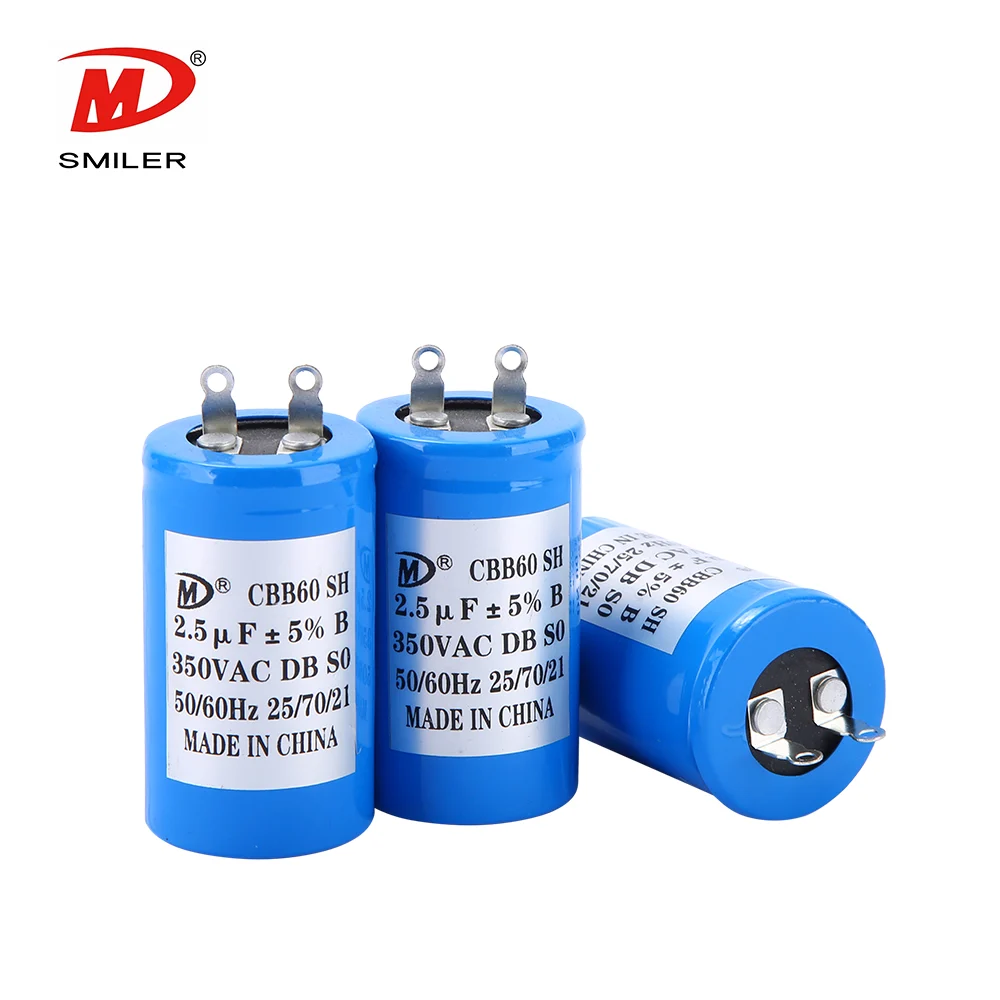
Disconnect power and prevent re-energizing. Discharge the capacitor with an appropriate resistor-based tool. Verify zero voltage before handling terminals. Isolate at least one lead when required. Then use a capacitance meter or LCR meter. Compare the measured value with the stated tolerance. Also consider the instrument's accuracy.
Do not treat a capacitance reading as a complete safety test. A capacitor can perform differently at operating voltage, frequency, ripple current, and temperature. Inspect the case and terminals for swelling, cracking, leakage, corrosion, heat discoloration, or loose connections.
Select a capacitor with a suitable VAC rating, AC motor duty, temperature capability, dimensions, lead length, and terminal arrangement. Check that the mounting method resists vibration. Make sure the terminals cannot contact adjacent metal. Confirm that the motor's start and run current remain within the design assumptions after replacement.
SMILER capacitor supplies CBB motor-run families using metallized polypropylene film. The CBB61 capacitor family is listed for fans, ventilators, air purifiers, and other single-phase motors. CBB60 serves a related but distinct application family. Our team can review the original label and operating context before a buyer evaluates a 40uF, 450VAC candidate.
The AC motor capacitor category gives additional family-level context.
μF controls the listed capacitance. VAC describes voltage withstand under rated conditions. They answer different questions. Replacing a 40uF capacitor with a different μF value because the voltage matches can change motor current and torque.
A higher voltage rating is not a universal upgrade. The part must still have the correct capacitance, duty, temperature, terminals, and mechanical fit. A larger case may also create clearance or mounting problems.
Repeated starts, high ambient temperature, vibration, voltage variation, and poor airflow can shorten capacitor life. Selection should consider the actual operating profile and expected lifetime. It should not focus only on the label's 450VAC and 40uF text.
A: μF means microfarads, the unit of nominal capacitance. It indicates the capacitor's charge-storage value per volt and influences the phase relationship in a single-phase motor circuit.
A: It is the rated alternating-current voltage under the manufacturer's specified conditions. It does not change the capacitance value and does not by itself prove suitability for a particular motor.
A: No. The motor's required capacitance, voltage, frequency, duty, tolerance, terminals, temperature, and physical fit must all be checked.
A: It may be possible when capacitance, duty, frequency, temperature, size, terminals, and the equipment specification also match. Voltage alone is not enough for a safe substitution.
A: Isolate power, discharge it safely, disconnect a lead as required, measure capacitance with a suitable meter, and compare the result with the marked tolerance. Inspect the surrounding motor circuit as well.
 Add
Building 12,Huazhi Technology Innovation Center,28 Sanle East Road,Beijiao,Foshan,Guangdong,China
 Phone
+86 18007576965 / 0757-22391591
 Email
ari@sml-cap.cn