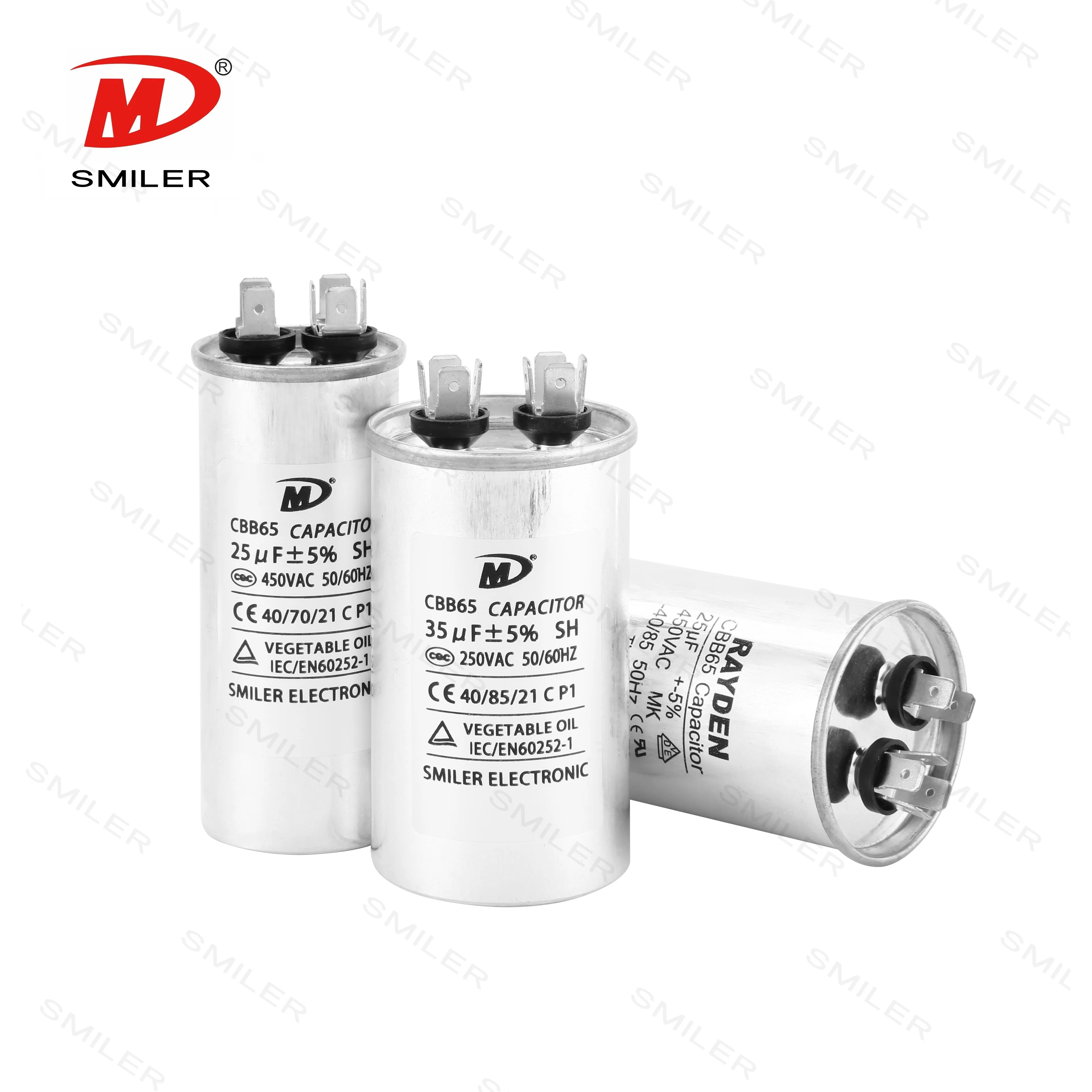
Suppose the fan is motionless while the compressor hums. Which part should be ordered? None until the circuit has been tested. An AC capacitor is one candidate. Once a failed section is confirmed, the replacement must still be matched to the unit. One can may carry a single capacitance value and another separate values for fan and compressor, despite similar housings. Use the unit diagram and the old label, not bracket size, to match the part. The photographed labels below make that difference visible. The homeowner describes what happened; an HVAC technician handles electrical tests and wiring.
Write down what the unit does before suggesting a part. If the fan turns while the compressor hums, note it. A running compressor beside a still fan is a different clue. Record a slow start or a shutdown after the unit has run. A weak AC capacitor may be involved because the motor needs its specified capacitance; a failed contactor, motor fault, loose connection, or supply problem can look similar. More examples appear in our warning signs for an AC condenser run capacitor.
Was this the first startup, a restart, or a stop after the unit had run? Which motor was affected? That is a starting point for the technician's tests, not a diagnosis of an AC capacitor. The homeowner can leave the electrical compartment shut and pass along the observations.
Record a bulge, an opened vent, or oil near the can. No visible damage? The AC capacitor may still read outside its marked tolerance. The meter gives that answer. It does not check the rest of the motor circuit.
Turning the thermostat off does not deal with stored charge. Before handling terminals, the technician isolates the supply and verifies absence of voltage. Discharge follows the equipment procedure. Any measurement taken while the unit runs is energized service work for trained personnel. A homeowner can describe the failure without opening the cabinet.
Record each wire's location before moving it. On a dual run AC capacitor, C, HERM, and FAN mark common, compressor, and fan connections. C on the capacitor is not C on the compressor. A photograph may help, but the unit diagram governs reconnection.
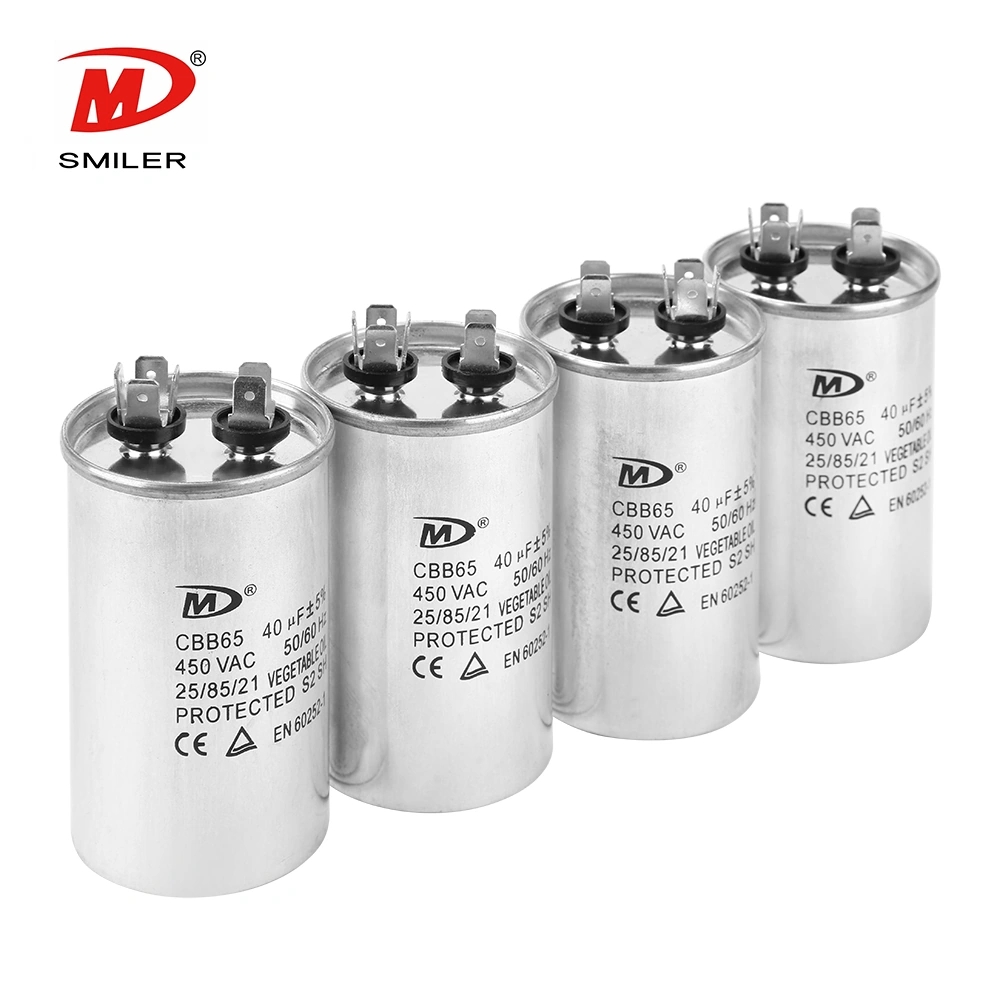
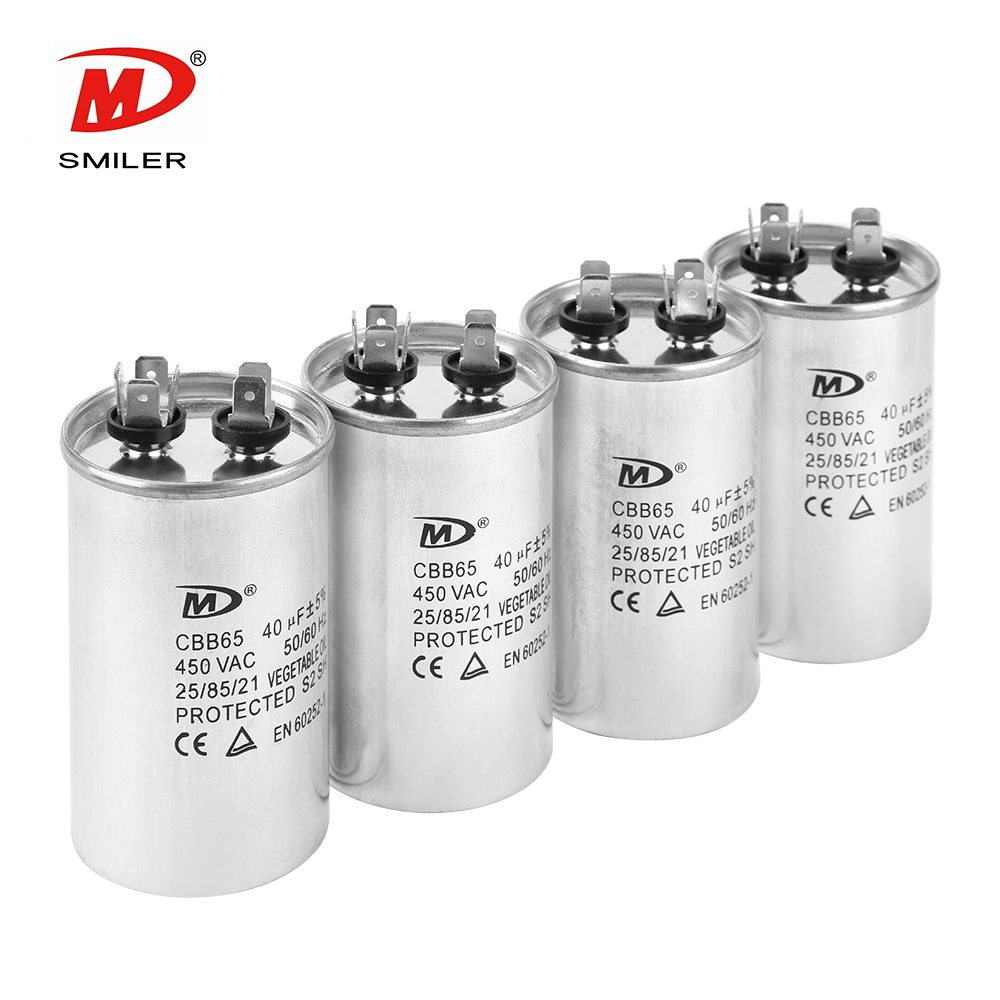
On an isolated, discharged part, the technician measures each section in microfarads (µF) and checks the result against the tolerance on that label. The pictured CBB65 shows 40 µF ±5%. The allowance is 2 µF either side of 40, putting this section's label band at 38–42 µF. The actual unit's label and documentation govern its service decision. Outside the marked band, replacement of the AC capacitor is justified. Inside it, the technician needs to look elsewhere in the circuit.
Match capacitance first. A run capacitor stays in the motor circuit; a start capacitor serves another function. A dual run can has separate compressor and fan run sections. Look at the pictured CBB65: 50+5 µF names two run values. Those are two run jobs, unlike a single 55 µF or a start-and-run part. The equipment specification and original label determine the air conditioner capacitor size for each section.
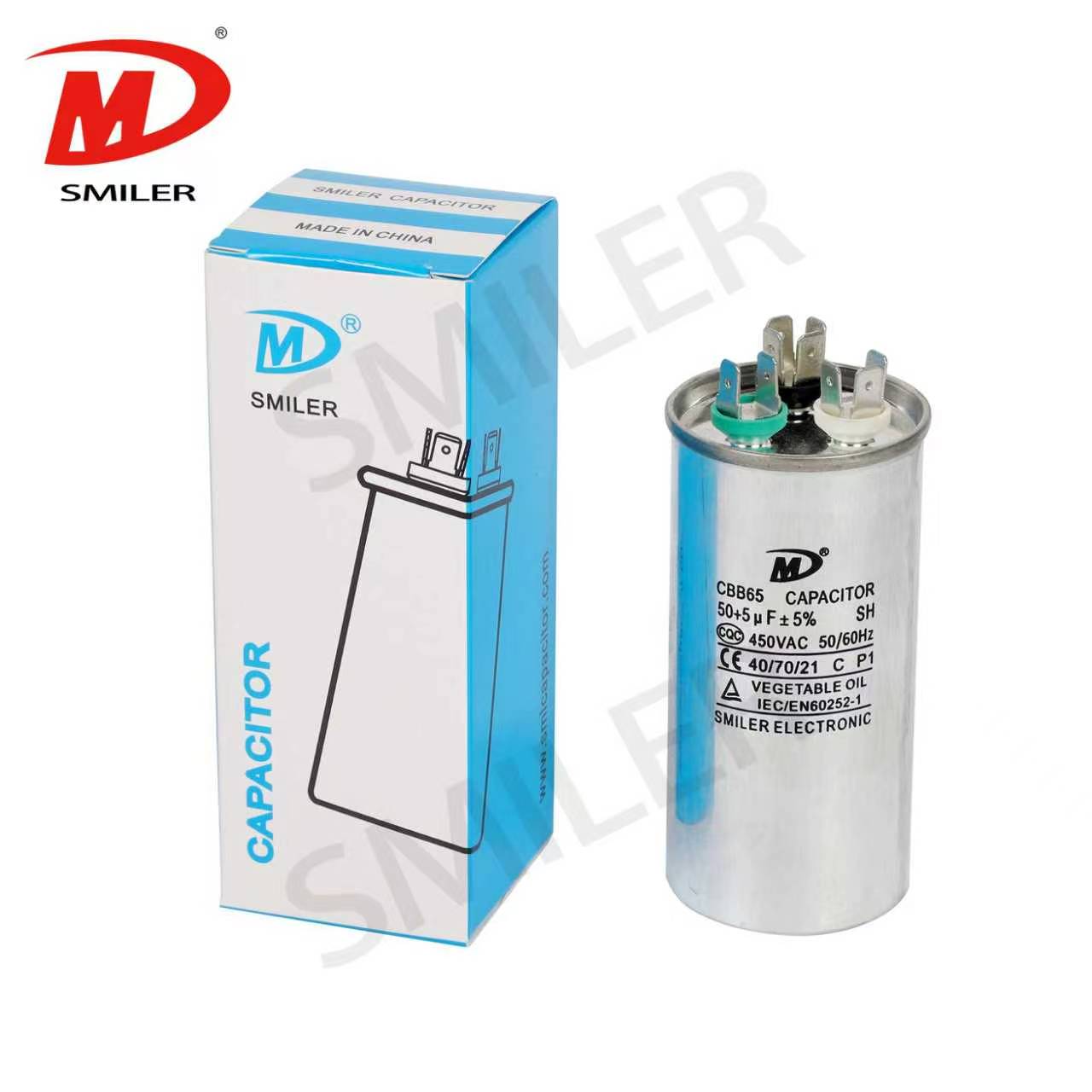
The CBB65 range listed by SMILER capacitor includes AC capacitor options for starting and running single-phase motors on 50/60 Hz supply. Air conditioners are among the listed uses. Metallized polypropylene film sits inside the aluminum can, with self-healing construction noted in the specification. The range includes single and paired capacitance options. To choose a part from that range, a buyer still needs the particular motor's duty and values.
Next read the AC voltage rating. A replacement cannot be rated below the application requirement. A higher rating is possible only if µF, run function, equipment instructions, and fit agree. Line voltage alone cannot settle the AC capacitor rating because voltage across the motor capacitor can differ from it.
Put the original part, equipment diagram, and candidate label side by side:
Compare | Confirm before ordering |
Function | Start, run, or dual run duty required by the unit |
Capacitance | Rated µF for each section, not just one matching number |
Voltage | Required AC rating and the new part's marking |
Connections | C, HERM, FAN, or other terminals against the unit diagram |
Housing | Case shape, mounting, and available clearance |
If the old label is unreadable, use equipment or motor documentation. Case diameter cannot reveal µF or duty. Check terminal layout and mounting separately after confirming the electrical values; a similar-looking AC capacitor may still be wrong.
Before restoring operation, compare the actual wire positions with the unit diagram and close the panel. Run the equipment under its service procedure and check the previously affected motor: does it start and stay running? If the complaint remains, return to the circuit diagnosis. Record old and new ratings, measured capacitance, connections, and other defects found.
For a CBB65 supply question, send SMILER capacitor the required µF values, voltage rating, motor function, terminal layout, and housing limits. We can compare those details with available configurations. Fitting and testing follow the equipment maker's service instructions. If the old label is unreadable, the unit's documentation must supply the missing AC capacitor rating. A photograph of the case cannot do that.
A: Yes. A clean case does not settle the reading. After isolation and discharge, the technician measures each section against the label's µF tolerance. A swollen top or oil is useful evidence of trouble. The absence of both proves little about the electrical reading.
A: That reading clears only the capacitance check. An in-range µF result sends the technician back to the contactor, motor, power supply, and wiring. The unit diagram shows where to test next. A hum alone cannot condemn the AC capacitor; it may still be there after an unnecessary replacement.
A: Check the run function and required µF first. Then read the equipment instructions and compare the terminals and case fit. A higher AC voltage marking may be acceptable on an otherwise compatible part. A lower marking fails the voltage requirement even when the capacitance matches. The larger number cannot repair a mismatch in motor duty or connections.
A: Read it as two run values for separate circuits, commonly compressor and fan. The equipment diagram identifies which section goes where. A single 55 µF can has one rating and a different terminal arrangement. The arithmetic sum is not a rating for either section on this can.
A: Leave the electrical panel shut. Record which motor tried to start and what you heard. The thermostat may be off while the capacitor still holds charge. A qualified HVAC technician disconnects power, verifies absence of voltage, discharges the part, marks each wire, installs the match, and checks motor operation. Swapped leads can introduce another fault.
 Add
Building 12,Huazhi Technology Innovation Center,28 Sanle East Road,Beijiao,Foshan,Guangdong,China
 Phone
+86 18007576965 / 0757-22391591
 Email
ari@sml-cap.cn