

The old part says CBB61. A supplier listing says CBB61 too. Is that enough to order? No. A ceiling fan capacitor has to suit the motor circuit and fit inside the fan. Compare the fan maker's specification with the complete old marking. If that marking has worn away, start with the fan model and wiring information. This ceiling fan capacitor checklist covers selection. A qualified person takes over at the mains wiring.
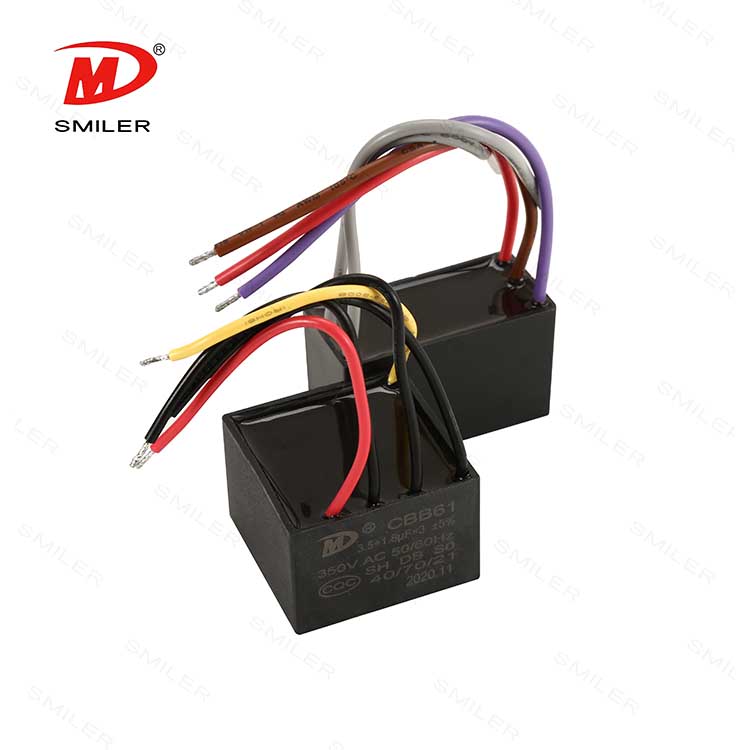
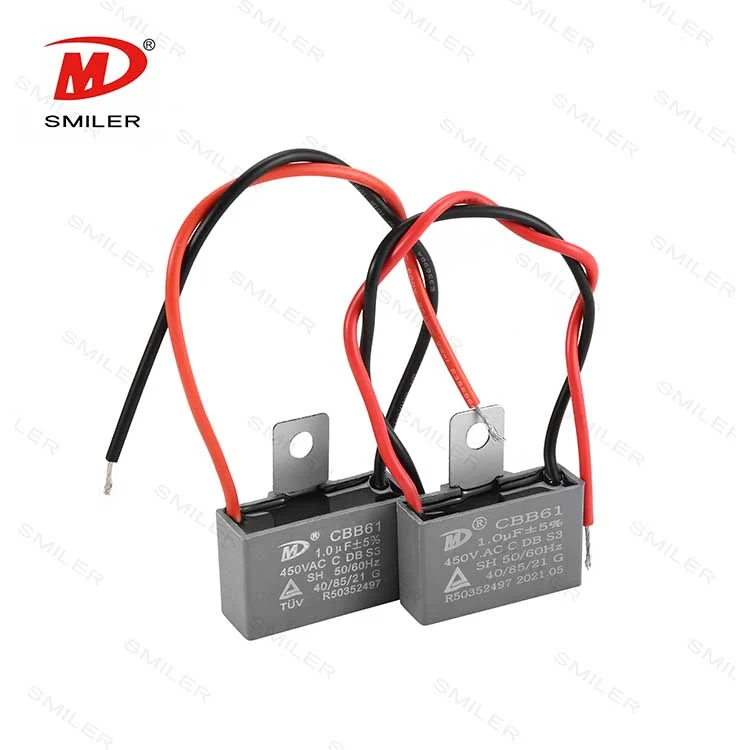
First, copy the old marking next to the fan model. CBB61 names a family, not its sections, lead arrangement, or fit in this fan. The ceiling fan capacitor in your hand may show one value or several. A supplier lookalike may differ. Transcribe the full marking before comparing them.
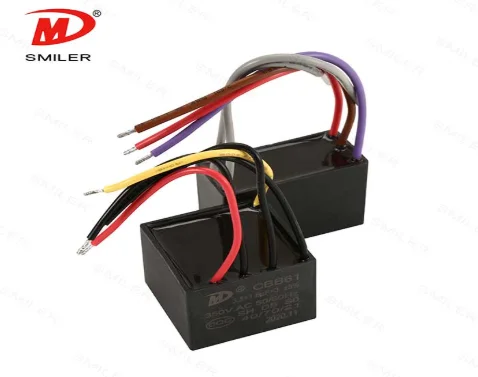
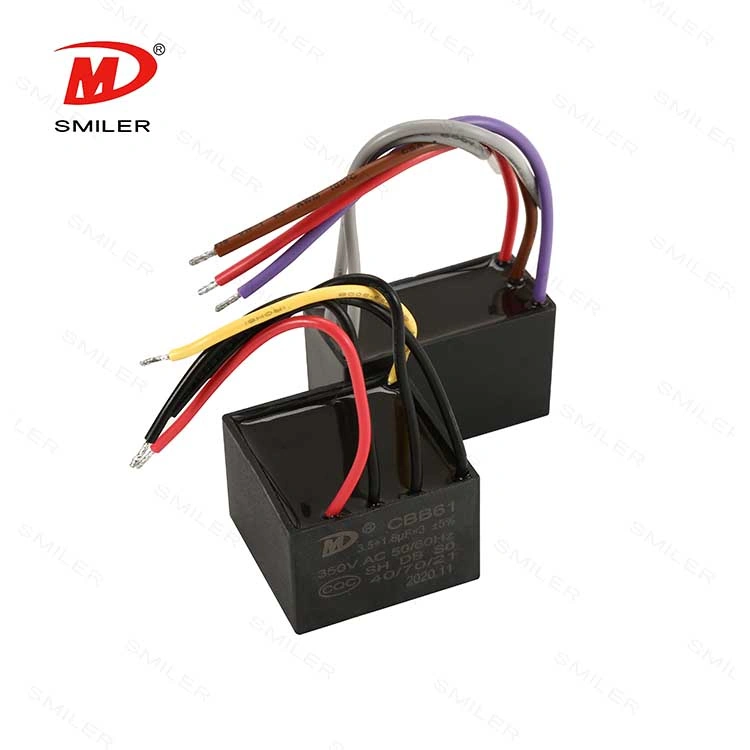
One rated µF value describes a single-value part. A multi-section unit may print several values on one case, with a lead designation for each section. Write those pairs down. Matching the first number does not establish that the other speed settings have the right values.
Some units share one lead between sections. Which two labeled leads belong to each measurement? The visible wire count does not answer that question. The fan diagram shows the circuit positions; the candidate label identifies its leads. Color is a poor shortcut when the parts come from different suppliers. No lead map? Ask the fan manufacturer for one, or have a qualified technician establish the connections. The technician isolates mains power before touching the wiring.
SMILER capacitor makes CBB61 ceiling fan capacitor parts from metallized polypropylene film for starting and running single-phase motors on 50/60 Hz AC power. There are several capacitance and voltage ratings in the family. None can be selected for a particular fan from the product name alone; use the values in its circuit specification.
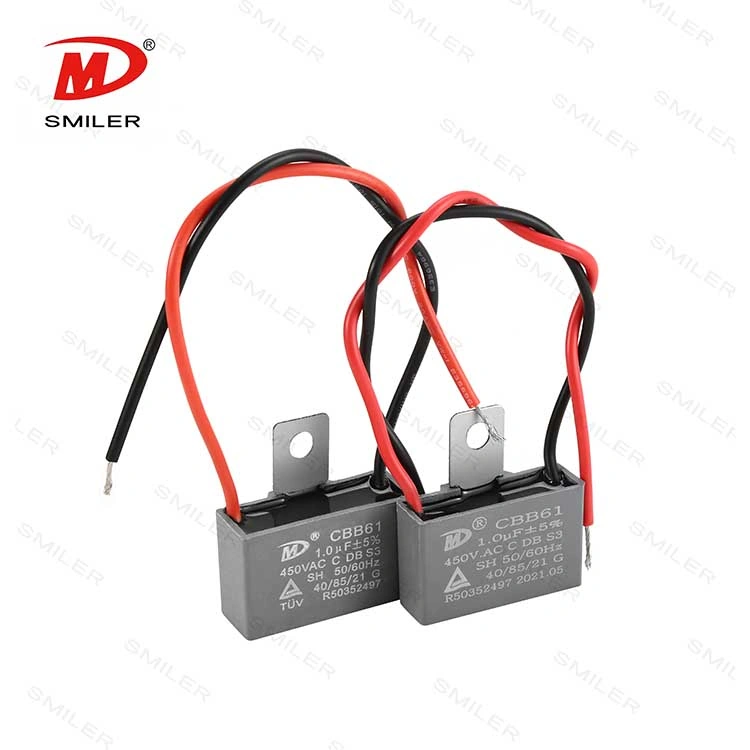
Use the fan maker's required µF value for every section. Tolerance matters too. If a requirement is 2.0 µF ±5%, its label band is 1.9–2.1 µF. At ±10%, a 2.0 µF label spans 1.8–2.2 µF. These are arithmetic examples, not permission to change the fan's tolerance. Check the candidate against the fan specification or approved original label.
A higher nominal value may change motor current and behavior. Before accepting a 4 µF versus 5 µF substitution, get the motor maker's approval. On a multi-section ceiling fan capacitor, each printed value belongs to a labeled connection. Adding those values tells you nothing about how the fan circuit uses them.
The voltage marking on a ceiling fan capacitor must be an AC rating. Reject a candidate rated below the fan's requirement. Going higher may be possible once the rest of the specification agrees. SMILER capacitor lists CBB61 ratings from 110 to 600 VAC, but that catalog range cannot name the rating for this fan. The fan specification can. Also compare supply frequency, running duty, and the temperature or climatic limits of a warm enclosure.
A DC-only marking cannot stand in for an AC motor-run rating. No stated AC requirement on the old part? Find it in the fan specification before selecting a replacement.
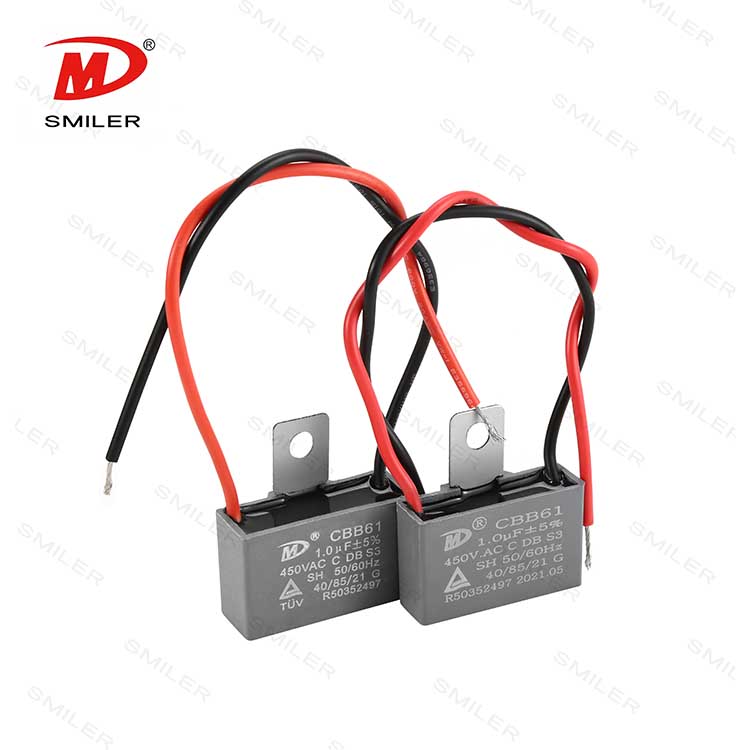
Published CBB61 dimensions show why matching µF is not enough. For the same 2.0 µF row in the SMILER capacitor table, the case changes from 31 × 10 × 19 mm at 250 VAC to 36 × 15 × 25 mm at 450 VAC. These catalog examples do not approve either part for a particular fan. Compare the candidate drawing with the housing and mounting space.
Lay the candidate beside the removed part. Where do the leads leave the case? Do its terminals and wire length reach the connection point? No lead should be stretched just to seat the ceiling fan capacitor. Ask the fan manufacturer about a changed footprint or lead pattern. Even matching colors cannot establish that the functions agree.
Review the fan specification, original label, candidate drawing, and supplier data together. A listing that says "fits ceiling fans" cannot fill in a missing section value or lead map.
Check | Compare | Release Only When |
Circuit | Fan model and connection diagram | The capacitor role and lead functions are identified. |
Values | Each µF section and tolerance | The candidate matches every approved value. |
AC rating | Voltage, frequency, duty, and climate | The exact part covers the required conditions. |
Leads | Labels, count, terminals, and length | Every connection maps to the fan circuit. |
Housing | Case drawing and mount | The part fits without wire strain. |
Leave the purchase open if a row cannot be checked. Obtain the missing specification first. A qualified person installs the approved ceiling fan capacitor under the fan maker's instructions.
Send the supplier the fan model, old marking, circuit diagram, and available space. The ceiling fan capacitor request then specifies section values, tolerance, AC voltage, frequency, operating category, lead map, and case drawing. Check the proposed part against the approved circuit and housing before ordering in volume. Keep the accepted drawing for the next purchase.
The CBB61 range from SMILER capacitor spans different ratings and dimensions. For a fan program, our selection discussion begins with the circuit values and housing limits. A model name still leaves that choice open.
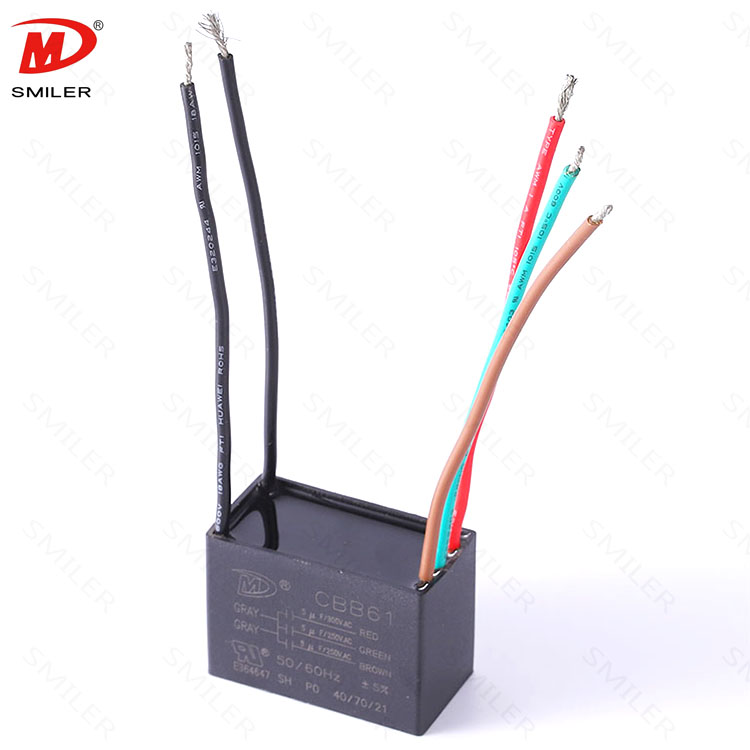
A: The CBB61 mark settles only the family. You still need the electrical values and a case that fits. With a multi-value ceiling fan capacitor, identify the lead assigned to each value on the old marking and fan diagram. Then compare the tolerance and AC rating. Do the cases match?
A: The voltage may be higher if the motor-running duty, µF values, and tolerance match the fan specification. Compare the connection layout and case drawing with the fan maker's instructions. If a section or the housing is wrong, the higher AC number cannot fix it.
A: A color match says little. Suppliers can use different colors for the same functions, while identical colors can hide different connections. Find each original lead on the diagram and look for its function on the new part's label. Missing either map? The fan maker or a qualified technician must identify the connections before installation.
A: Keep every section's µF value and tolerance at the fan maker's specification unless the maker approves a change. Changing the value may change motor current and behavior. A bigger case or a higher voltage rating addresses other requirements; it does not approve that capacitance change.
A: Start with the fan model and its circuit diagram. Compare each section value, tolerance, AC rating, frequency, duty, lead function, terminal, and case fit with the candidate data. File the accepted drawing with the order. A qualified person isolates the mains-connected circuit and installs the part as the fan maker instructs.
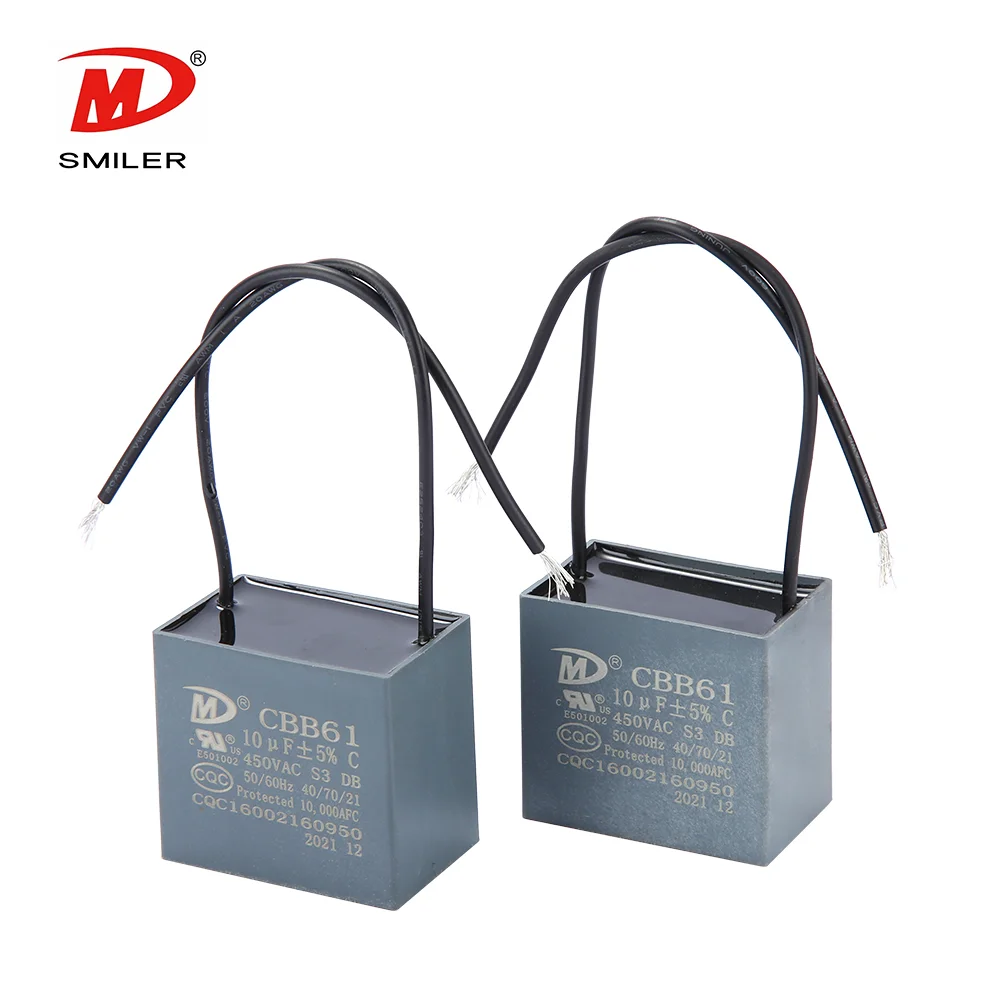
What Does a CBB61 Fan Capacitor Do? Exploring the Role of CBB61 Fan Capacitors
Mastering the Reset of Your CBB61 Fan Switch
What is a CBB61 Ceiling Fan Capacitor? Specs, Features & Applications
CBB61 Ceiling Fan Capacitor: Top Specs & Features
Analyzing the Functional Differences in CBB60 25uF 500VAC and CBB61 Capacitors
How to Test a CBB61 Capacitor: Step-by-Step Guide for Ceiling Fan Troubleshooting


 Add
Building 12,Huazhi Technology Innovation Center,28 Sanle East Road,Beijiao,Foshan,Guangdong,China
 Phone
+86 18007576965 / 0757-22391591
 Email
ari@sml-cap.cn



